Wednesday, April 20, 2016

A book party tonight at Toad Hall!


Meet Betsy (Donovan) Marro

Today my best friend Betsy Marro, is in Rockport, Mass. — all the way from San Diego — to talk about her debut novel, “Casualties.” Betsy will be at Toad Hall at 7. Please join us for a little wine and cheese (we’re celebrating), some good conversation and a short reading. Betsy has generously donated a $25 Toad Hall gift certificate, to be raffled tonight. We are planning on a very good time for all.

Betsy used to live here and work as the Rockport page editor and reporter for the Gloucester Daily Times. Some readers will remember her byline — at the time her last name was Donovan. I was so taken with Betsy’s creative newswriting that I enlarged the focus of my college studies to include journalism. We first met at UNH where we were both single moms getting our degrees.

Today I am thrilled beyond words to celebrate Betsy’s homecoming and the publication of her beautiful novel in my favorite bookstore, Toad Hall. It so happens that my daughter Ardis, a librarian, is now Toad’s manager and is the one who worked with Betsy to set up the reading. We love and work on behalf of good books in my family. As we are wont to say when auspicious convergences thrill us — “Who would have guessed?” Friends, old and new, gather in a small bookstore on the rocky coast of a lovely little town at America’s edge to welcome readers, celebrate literature, hug each other, and acknowledge a beloved author’s awesome accomplishments. Please join us.

Welcome home, Betsy!

Below is my review of “Casualties” as well as a Q&A I wrote, both published earlier in GateHouse Media newspapers.


A long, hard journey home

Casualties
By Elizabeth Marro. Berkley, New York, 2016. 358 pages. $15.

Elizabeth Marro’s affecting and beautiful first novel, “Casualties,” does not shy away from shame, regret and self-loathing — the underside of parenting. She takes us places we don’t want to go, makes us look, makes us feel. Her characters’ journey becomes ours and, as a consequence, we exult in their hard-won reckonings.

“Casualties” begins on the West Coast, in San Diego, where Ruth Nolan, an executive for a company that supplies contractors to support the military in Iraq, sees her own son Robbie enlist in the Marines and take two tours of duty in Iraq. She must put on a good face, given her work and all the ex-military in the company, but she is distraught. And relieved. For once, she does not have to carry all the responsibility for her troubled son.

Ruth and Robbie’s interdependence is fraught with frustration and hurt. Ruth raised Robbie by herself, almost from the beginning. While still living on the East Coast, she separated from his father in order to join RyCon, a startup at the time. Robbie’s father was later killed in a skiing accident. Loss was a constant for Ruth. Her mother walked out on Ruth and her brother Kevin when they were young, leaving the maternal grandparents to raise them on family farm in northern New Hampshire. What family Ruth and Robbie have left live in northern New Hampshire, a part of the country Ruth couldn’t wait to escape. She felt confined and limited there, while Robbie loved the mountains, the family, the farm work, the fishing.

Mother and son, alone together in San Diego, tackled life head on. Ruth, competitive and ambitious, helped grow RyCon as she tried to help Robbie with his demons, including depression. But Robbie resisted Ruth, whose demands and standards were not a good fit for him. They butted heads in what feels like all-too-familiar, perhaps inescapable family dynamics.

Robbie’s suicide, which reads as inevitable, is nonetheless a loss Ruth cannot comprehend. It is a suicide that, while provoked by war, has deeper roots and Ruth knows that. There are reasons she feels responsible, complicated as they may be, and her unbearable pain prevents even the possibility of grieving. She does the one thing she and Robbie enjoyed together — she gets in her car and drives. And thus we head into the heart of the story.

On the road, Ruth meets Casey, a 36-year-old injured veteran who has settled for a scrap of a life gambling in casinos and sleeping off benders in a tiny trailer. He suffers pain from an ill-fitting “faker” or prosthesis and he endures bad headaches. He reluctantly helps Ruth after she is brutally attacked in a parking lot in Nevada. Their brief but life-altering connection, made during a road trip to the East Coast, is intense, at times ugly, and, finally, redemptive. The need for absolution is all-powerful and never guaranteed. Kudos to Marro for diving in and surfacing with our hearts in hand.

“Casualties” is also adeptly plotted. RyCon, unbeknownst to Ruth, had failed to process insurance paperwork for many of its military contractors in war zones. A pending merger with another, bigger company may have spurred these questionable business practices. Families and injured contractors’ insurance claims have not been paid, and they begin a visible and condemning protest outside RyCon’s offices just as Robbie gets back from Iraq.

Ruth discovers, once on the road, that RyCon’s owners — her longtime colleagues —purposely circumvented rules. She must decide whether to provide information that may help the contractors’ case against RyCon. If she does blow the whistle, she will lose everything — her investment in the company and her professional standing. At 47, she will be totally discredited.

Loss, both the kind you do not ask for and the kind you invite, does not mean starting over. It does not mean giving up. Marro has other plans for loss. Loss is sometimes the clearing out of the path we take to heal ourselves of wounds long neglected. Loss opens up to vision.

Marro (known as Betsy Donovan when she worked on the North Shore) now lives in San Diego. Early in her professional career, she lived in and reported on Boston’s North Shore, including Rockport and Salem, Mass., for what was then Essex County Newspapers. She will be on Cape Ann and Portsmouth, N.H., to read from “Casualties” in April.
                                                                — Rae Padilla Francoeur

Rae Padilla Francoeur’s memoir, “Free Fall: A Late-in-Life Love Affair,” is available online or in some bookstores. Write her at rae.francoeur@gmail.com Read her blog at http://www.freefallrae.blogspot.com/ or follow her @RaeAF.


Author Elizabeth (Betsy) Marro comes home to read from debut novel

Author Elizabeth Marro will read from and speak about her debut novel, “Casualties,” at Toad Hall Bookstore in Rockport on Wednesday, April 20, at 7 p.m., and at RiverRun Bookstore in Portsmouth on Thursday, April 21, at 6:30 p.m.

Marro grew up in northern New Hampshire and studied journalism at the University of New Hampshire. She went on to complete internships with Essex County Newspapers, and to report for The Gloucester Daily Times. Her readers knew her as Elizabeth (Betsy) Donovan. She now lives in San Diego but frequently returns to the area.

“Casualties,” which has been receiving stellar reviews, begins in San Diego, where Ruth Nolan works as an executive for RyCon, a company that supplies contractors to support the military in Iraq. She sees her own son, Robbie, enlist in the Marines and take two tours of duty in Iraq. She must put on a good face, given her work and all the ex-military in the company.

Mother and son, alone together in San Diego, tackle life head on. Ruth, competitive and ambitious, helped grow RyCon as she tried to help Robbie with his demons, including depression. But Robbie resists Ruth, whose demands and standards are not a good fit for him. They butt heads in what feels like all-too-familiar, perhaps inescapable family dynamics.

We spoke with Marro about writing “Casualties,” a novel cited for its beautiful and moving portrayal of mother, son and grief.

Q: The mother-son relationship is fertile ground. How were you able to achieve that palpable tension between Robbie and Ruth?

Marro: These relationships are the biggest stories of our lives. If nothing else, they leave their imprint both as a child and as a parent. It was surprisingly easy for me to access that dynamic. I felt I had an ear for it and am attuned to it. I am a parent and I have witnessed many parents and children, have heard how sons talk to their mothers. And I’ve been around a lot of young men as my son grew up. It was a very different thing than being around my brothers when we were growing up. So the how part of this question is answered by experience, though the relationship between Robbie and Ruth is much much different. Also, I wrote many scenes that never saw the light of day in this book, when Robbie was much younger. The parts we see came from parts I wrote that we don’t see.

Q: Another compelling conflict is Ruth’s desire to flee her New Hampshire home as soon as she can get a job and get out, versus Robbie’s strong desire to go back to New Hampshire, especially after his wartime service. Both characters’ drives, though opposing, come from a similar need for separation. Was this conflict something you set out to explore?

Marro: Ruth wants to peel out of there as a very young woman and Robbie wants to go back at about the same age. There are little breaks from your family as you go along, but when you are of age, that’s when the biggest break comes.

Home is what you leave and it’s always what you carry with you. It’s also what you need at different times in your life. Ruth never really felt at home and wanted to make a home somewhere. Yet there’s a softer part of her when she speaks of her brother and grandmother.

But with Robbie, the need is to go back to New Hampshire, the place that felt like home. I’m thinking more that he’s going back to reconnect with himself and a good part of his life, and he’s thinking it will help him in some way. For him, it’s more of a refuge. He wants to go to the last place he felt safe. When he left San Diego, he joined the Marines and they became his family and his home.

Q: Few first novels get published. Yours did. Can you talk about the steps that led to publication of “Casualties”?

Marro: So many people say the first one you write never sees the light of day. Over 10 years I worked on this novel and I can count two other novels worth of pages that I wrote and took out. I’ve tried to write it more than once. I had to put it away for a while and ask myself, when finally returning to it — Is there anything here? It called me back. That led to a better draft. Six hundred pages went away in the process and my husband said, “All right, just go ahead and finish it.” Also, I should add that I’m a demon for closure. When I start something I can’t move on to another project till I finish the one I’m working on.

Q: How did you come to your fine ending?

I had found what I thought was the ending. But my agent pushed me further. She said she wanted a better sense of a chance of resolution, that there is a life after all that had happened. That a reader can more readily speculate about what comes next. With that in mind I went back and this ending materialized and I liked it better.

Q: Ruth is rescued from a dire situation. Why was that essential to your story?

The reason I put Ruth in some pretty rough moments is that her self awareness is not that acute. You want someone to take over the punishment you can’t give yourself. That would be the character Casey. And I thought that Casey’s rescue of Ruth showed his soft streak.

Q: How did Ruth and Casey’s road trip serve you as a storyteller?

From a storyteller’s perspective, they are each on a journey and the road trip helped me to structure the book. It gave me space and time. Felt very natural. I’ve personally taken long road trips at different times in my life and even the most boring one left me with a different sense of the world from when I started out. And there’s nothing quite like closed quarters to bring people out fast. There’s an almost physical friction that wears away the coverings we put on everybody. Also I like that element of being in another world — you’re going through it but not really in it.

Q: Finally, what’s it like, coming home with this book?

Marro: It’s completely emotional. For me, it was always something I had hoped to be able to do. Everything I finished here in San Diego got started in New Hampshire where I grew up and in Rockport, the place I think of as my second home. The first idyllic experience I ever had happened in Rockport. I have so much connection in my heart, even though I haven’t lived there for years. Everybody back home knew what I was trying to do. This is really a coming home deal for me. I celebrate that.

                                                                            — Rae Padilla Francoeur


Thursday, March 31, 2016

Let’s modify the winter parking ban in Rockport


This is what downtown Rockport 
looks like in winter. It's beautiful, 
especially when the Christmas trees 
are up, but it looks like a ghost town.


The winter parking ban in Rockport has outlived its usefulness. It’s time for the town to replace the four-and-a-half-month overnight parking ban with a ban during snow emergencies only.

This fall we spoke with many of our downtown neighbors and businesses, and found that most share our desire for change. My husband went door to door downtown and in surrounding neighborhoods. He took the time to speak with shopkeepers and neighbors, and left a copy of the proposal with them. He and I returned a few days later with a petition. My daughter also chatted with residents. Of the more than 100 people we spoke with, only two did not sign the petition.

The ban should be changed because:

  • We have a Red Alert system that can let us know when there’s a snow emergency.
  • We have a changeable sign system near the police station that can also broadcast snow emergencies
  •  Rockport has a great, new website that can display snow emergency notifications just as it now displays notices of the winter parking ban.
  • Almost everyone has a cell phone or computer and can check the website.
  • Storms are now forecast days in advance.
  • Things have changed a lot in the few years. Only a couple of motel owners now rent overnight spaces.
  • Residents pay $150 and up to rent these scarce parking spaces.
  • There aren’t enough resident parking spaces in the town lots and we have to pay to park there, as well.
  • Handicapped and elderly residents have a hard time walking to and from distant lots in the dark and cold months of the year.
  • The empty streets give Rockport a bleak, vacant look that is bad for business. The Rockport Economic Commission is spending taxpayers’ dollars to attract visitors to Rockport in the shoulder seasons and to interest young families in settling here. If we look less like a ghost town in winter, we can help businesses, including restaurants, stretch their season.
  • We will be able to come and go more freely at night, especially downtown. This activity will signal to our neighbors, residents, and the rest of the world that Rockport is open for business.
  • We should be considerate of the downtown business district for the period of time when meters are not monitored in order to discourage people from parking in front of businesses all day. Law enforcement should be vigilant.
  • With the help of our local papers and social media, we can easily communicate the ground rules of the new system. Violators will be fined and towed. They won’t violate the rules for long if we rigorously enforce this plan from the start.
  •  Implementing a residents’ Winter Parking Task Force to work with the police, DPW and the community, like we did when we implemented the leash law, will ease the transition.
  •  Plows work around parked cars throughout the day as it is.By implementing an emergency ban, there will be no cars on the streets during the storm, regardless of the time of day.


Wednesday, December 31, 2014

Nature Nosh


It's starting to look like winter in these woods.


It’s been a hard week.

Most days I’ve been at my computer at 6 am banging out work on deadline. Personal issues too tricky and morally ambiguous to share with friends send me on a 14-day course of Prilosec. The usual Christmas-and-I-am-an-atheist-and-on-a-tight-budget dilemma gets papered over with lots of gift-wrap and tied up in red and green ribbons. Oh well. Five worrying water leaks made worse by four Nor’easters that rammed my northeast-Atlantic-facing Rockport home this fall shake me sleepless every time it rains. And it rains all the time.

I think I’ll stop right here.

Because I’m writing about what happens when I step into the winter woods — which surround me in Rockport. This is when my consciousness shifts from the pain that’s tearing at my stomach to the impossibly verdant green of the moss on the Kieran Trail. To the deeply resonant, hallowed hoot of the Great Horned Owl. To the slippery log bridge that traverses yet another swollen, rocky stream.

Pay attention. Don’t fall in.

Because I’m writing today about what happens to us on a recent woods walk on one of the worst of the hard days. My friends Ruth and Matt let me tag along on their daily 3-to-4.5-mile woods hikes if our schedules mesh. These lunchtime excursions into Dogtown and the South Woods are ostensibly for the standard poodle, Maggie, and the golden doodle, Ellie, who have yet to experience exhaustion. They go and go. We keep up; maybe grow a bit stronger day by day.


Maggie and Ellie never think the water is too cold.


As we often do, we set off for South Woods. Matt knows every trail in these networks of trails. He can judge hiking times regardless of the creative trail braiding he does as we weave this way, then that. And on this day he veers off course and leads us somewhere new.

As beautiful as this new pocket of woods is, we are dismayed for underfoot is a continuous trail of broken glass. We crunch our way to an elevated granite clearing that exposes a 360-degree-view of feathery young, green pines; seemingly impenetrable woods to the west; and strewn about — half-burnt logs, scores of broken bottles, discarded cans and food wrappers. Someday some archaeologist will class this site “Party Mound” and shake her head in incomprehension.

We vow then and there to come back with bags, brooms and dustpans and clean it all up. This will be our Christmas gift to the woods. The perfect ‘give-back’ effort we’ve been seeking, right here.

Someone has strung and wound popcorn around this maple.


We turn, eventually, and crunch back the way we came for a quarter mile or so when, noticing a single strand of popcorn wound round a maple trunk, Matt steps off the path and though we wonder about this deviation from the course, we do the same. He has some adventure in mind, perhaps?

Wait a minute.

“Look!” Matt is ecstatic.

We cannot not believe our eyes.

We reorient our sights. Refocus. Narrow down and look sharply all about us.

Everywhere, in all directions, we see beautiful, edible decorations. The woods transformed. South Woods as Christmas tree. Just brilliant!

There are millet seeds embedded in slices of bread that have been soaked in honey and peanut butter. Ice cream cones filled, not with chocolate chip ice cream, but with lard and seeds and nuts and dried fruit. Plump cranberry chains. Luminous slices of orange aglow in the afternoon light. Bits of dried apricot dangling from low-hanging branches. Pinecones stuffed with fruits and fats and seeds. Carrots. Celery. Apples. What a spread! A nature nosh, I say, only half joking, for I nearly hit my head on half a bagel strung from a tree on a piece of ribbon.

 Luscious berries!


Apricots and berries looped around a branch. 
So full of light they are hard to photograph.


Nuts, berries and lard in an ice cream cone. Pemmican for birds.


A stuffed pine cone. Inspired, I went home and made stuffed artichokes.


Bacon strung on a wire sculpture.


Melon, too!


A study in textures.


Here's to a good nosh!


Gifts for creatures of all sorts.

Who did this?

We look for the sparrows. Chickadees. Grackles and stray waxwing — be here, please. Cardinals and jays — flash your blues and reds this way. Fill up. Our feast is for the eyes and the soul. Yours is more essential. Winter will set in for real. There will be snow and cold and wind and ice that make foraging all but impossible.

Scouts? Bird watchers? Neighbor? Who amongst us did this?


A wonder of nature, strung from a tree.

Thank you. This perfect slice orange, a miracle all by itself, lights an afternoon woods. It lights my heart, too. Soon it will please, in far more important ways, another unsuspecting critter.

Happy New Year to my friends and to the friends of nature who tend to the trails and all that roam there.


Tuesday, December 2, 2014

My second Thanksgiving: Long lost friend, found


Heading north


I hadn’t seen my friend Myv for fifteen or twenty years. Something came between us, I don’t know what, and we lost touch with each other. Then I heard she moved away. Years and years went by. I found her on Facebook and sent a friend request that languished. More years passed.

I thought often of Myv for I was quite fond of her. We had a lot in common and we had, at a certain time in our lives, spent good times together. She read many of the same books I did, loved many of the same authors I loved, and she looked forward with relish to the Sunday New York Times Book Review. Sometimes we would have Sunday supper together and talk about the books reviewed there.

Myv told me she maintained a running list of the books she wanted to own and read. When they came out in paperback, she would purchase them and check them off the list. Her patience and her enduring passion — waiting a whole year for a book she really wanted to read — impressed me. There are few people who can converse as thoroughly and as enthusiastically about books as Myv, and this might be a source of disappointment to her. It makes sense that she reads and rereads Christopher Hitchens. He is a spiritual soul mate. She even named a pet Sports Fan in honor of Richard Ford’s book “Sportswriter.”


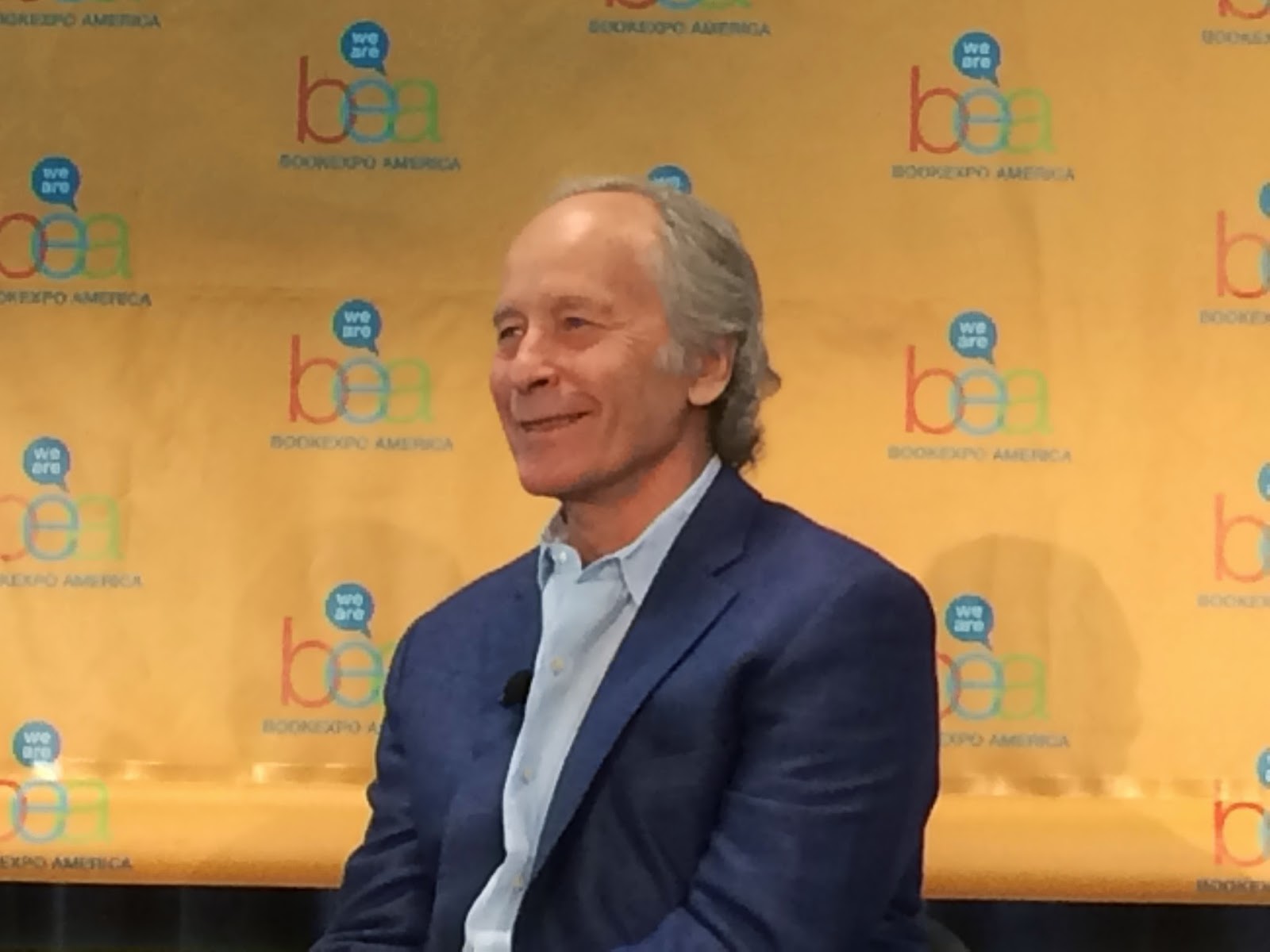
I saw Richard Ford at BookExpo America last spring, 
and I sent Myv this picture of him. 
He looks good and his new book, 
"Let Me Be Frank with You," came out November 4.

Myv is a wonderful cook. She is an artist who, to my amazement, can paint and watch TV at the same time. And she can fit herself into any social situation and hold her own. I used to love looking at her gorgeous journals full of notes she made in thick, black ink. She chooses wide-nibbed pens and writes in bold, block letters. I read her as daring and unabashed. I see her as incapable of holding back, as compelled to make a strong impression. Myv lives her aesthetic. She is her aesthetic.

Myv is the first friend I made when my daughter and I moved, alone and with very limited resources, to Cape Ann from New Hampshire. We met in a casual, loosely structured group of men and women gathered to discuss personal issues. I had just left a full, rich professional life, a long-term relationship and scores of good friends. I was starting over from scratch. And there was Myv, someone who caught my interest immediately.

We had a lot of fun till it all stopped.

Thanksgiving came twice this year for me. On November 27 I had a fabulous time eating, talking, joking, playing charades with good friends and family. We laughed a lot. It was as close to the ideal Thanksgiving as I have ever had though there was little tradition to it beyond all the special dishes that cleaved to the dictates of habit and preference.

And then, after driving from NYC to Rockport, after cooking all day, after washing and drying load upon load of sopping wet towels when my house sprang leaks during Wednesday’s Nor’easter, we got in the car again and drove another 170 miles. We drove north and west. We drove up into a network of snow-covered roads off the Kancamagus Highway in New Hampshire. So utterly beautiful, this place where every pine needle was encased in snow — a high-definition moment of lasting wonder struck through with a sense of unease, of navigating on ice, of going blind into the unknown. I gasped, awestruck and unnerved. Defenseless. We drove on and the thermometer plummeted. We drove on till the road became impassable and we turned around.

Try again. Don’t give up.


This is Myv's front yard. The shed decomposing to the left 
of the picnic table is the first cabin built on this site. 
To the right is the kitchen for that cabin.


We tried another road, drove on till we found Myv, living in a semi-winterized cabin, heating with wood, smiling, welcoming us as if those twenty years had never come between us. Sometimes twenty years feels like the blink of an eye. Sometimes twenty years is nothing more than the blink of an eye.
And that’s how it often is with friends. We find each other early in life and we bond. Then we move away, pull away, go away, drift off. However it happens, we find ourselves apart. We get busy with work and kids and lovers and we lose track, not because we don’t love each other, but because we can go decades with little in common. Something triggers a reunion, be it renewed proximity or a health scare or a fierce longing for what once was. In my case, it was all of the above.

We arrive with smiles, some goodies, and anxious concern. If a dog can be a harbinger of good will, then Myv’s huge puppy, bounding and bouncing, spoke for all of us. We are so happy for this moment.


Here is Myv's cabin and, of course, 
her big and exuberant puppy, Desmond. 
Myv took this photo before the snowstorm.


We stand at Myv’s threshold and take a long breath. It’s time. We stomp our boots till the snow and ice fall away, we hand off the bag of treats and the bag of books, we hug each other hard, and then we step inside and pick up where we left off, closing the door on the dark night and the crunch and squeak of the snow and the slice of moon and the vast wilderness that holds Myv here, happy and game, as always, and keenly interested in what comes next.